Wednesday, December 15, 2021

Racism? In my economics textbook?

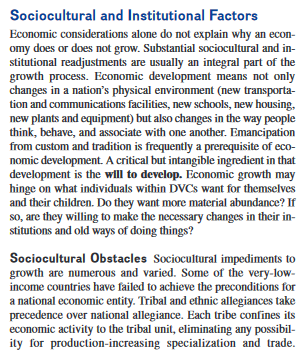
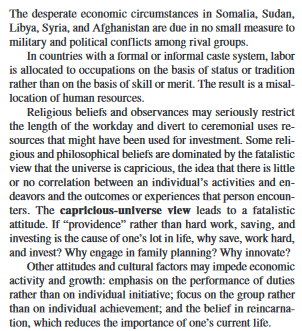
So, recently in a Discord server with a couple of friends, we decided to look at an old economics textbook: the 14th edition of Economics: Principles, Problems, and Policies, published in 1998. We, as heterodox economists, had thought we were just going to have a chuckle at the nonsense that was mainstream economics at least in the late 90s. What we encountered, however, was nothing less than shocking.

This was their section on the sociological obstacles to economic growth in developing countries:

Image 

Image

Now, we must remember that 70% of the world population lives in underdeveloped countries and the least developed countries are in Africa, and the authors of this textbook are American; in light of that, these passages are almost wholly racist. If I have to explain it, much of the reason why these underdeveloped countries are the way they are is because developed countries (namely the majority of Europe and America) have exploited their resources and labor, leaving them in the dust in comparison.

We, of course, had a disgusted chuckle to each other, noting how mainstream economists usually ignore imperialism and the analysis of it; I personally noted how my high school American history class managed to cover imperialism not only better, but more in-depth than this textbook. It was surprising looking at their coverage of developing countries and the "viscous cycle" didn't even mention how places like Europe or America had a role in underdeveloping Africa. It was a shame, we said, that this textbook likely got taught to classes at least 5 years after it was published.

We were curious what further versions of the textbook had to say about this same topic. It turns out it didn't change a single bit:
Image

 Image

 The fact that these racist lies were being pushed in 2017 (and likely still are in the 2021 edition) and are likely being taught in many classes through this textbook is not only disgusting, but also a dark reflection on the current state of mainstream economics. The second fact that this is published by the overly-expensive McGraw-Hill might leave salt on the wound, as well.

I am hoping, if anything else, to contact them about this textbook and the concerns I have over not only the accuracy of the claims made, but also the implications that are brought about by further, perhaps crude, consideration, i.e. Africa just doesn't want to develop and join everyone else in the economy. In the meanwhile, I'm hoping to bring awareness to this major flaw and perhaps in the future make a more focused criticism on the textbook's explanation of why underdeveloped countries came to be.

Sunday, December 12, 2021

Small Update

This isn't going to be anything major; I just wanted to make sure I didn't leave this blog as dry as a desert since last month.

--------------------

As a small update to my hobby of economics, I finally have a chance to get a real copy of Unorthodox Marxism in my hands once Christmas comes along; this means I'll be able to start getting a complete idea of what Albert/Hahnel have in political economy. I'm hoping to work on not only making a condensed version of the book, but to also have it up in either a Word document or PDF file so that way people can easily access it.

I'm not closer to really figuring out a generalized SRTV (however its possible that I may have ran into an issue; more on that later), however as a friend managed to help me find the elusive page 360, I find that Albert/Hahnel did start with a price for the first good (R):

But before I do anything else in regards to Unorthodox Marxism, I'm getting the book.

--------------------------------------------------------------------------------------------------------

As an aside on my IRL presence, I've recently been accepted into East Carolina University through their Pirate Promise program, which means that once I finish my associates degree at my local community college, I can transfer to ECU without hassle. I'll be able to continue working on my thoughts on economics more extensively there, and I hope to be able to provide more content to share on here (aside from Unorthodox Marxism, of course). I'm deeply grateful for this opportunity, and I hope to put it to good use in the future.

Saturday, November 13, 2021

An Attempt At A Generalized 3-Commodity SRTV

 The last post I made made a generalized 2-commodity example of the SRTV. Now, I've made a generalized 3-commodity version of it. I'm wary of the validity of the math yet again, however for the time being this should do.

Oh, and correction on that last post: I had ...+WL_R on the price equation for P_K, when it should've been ...-WL_R.

---------------------------------------

First, assume there are 3 industries that produce one good each, with all 3 goods being used in the production of these industries in some fashion:

https://latex.codecogs.com/gif.latex?%5Cbg_white%20%5Clarge%20%5Cbegin%7Bmatrix%7D%20%281+r%29%28P_AA_AN_A+P_BB_AN_A+P_CC_AN_A%29+WL_A%3DP_A%5C%5C%20%5C%5C%20%281+r%29%28P_AA_BN_B+P_BB_BN_B+P_CC_BN_B%29+WL_B%3DP_B%5C%5C%20%5C%5C%20%281+r%29%28P_AA_CN_C+P_BB_CN_C+P_CC_CN_C%29+WL_C%3DP_C%5C%5C%20%5Cend%7Bmatrix%7D

 Figuring out P_B and P_C from A will look a bit different, however they have the same structure:

 For the time being, we'll refer to figuring out P_C as I've calculated W based off of that and not P_B, unaware of the potential differences between the two.

The equation for W, then, is this hefty equation:

https://latex.codecogs.com/gif.latex?%5Cbg_white%20%5Clarge%20W%3D%5Cfrac%7B%5Cleft%28P_%7BA%7D-P_%7BA%7DA_%7BA%7DN_%7BA%7D%5Cleft%281+r%5Cright%29%5Cright%29%5Cleft%28P_%7BB%7D-P_%7BB%7DB_%7BB%7DN_%7BB%7D%5Cleft%281+r%5Cright%29%5Cright%29%5Cleft%28P_%7BC%7D-P_%7BC%7DC_%7BC%7DN_%7BC%7D%5Cleft%281+r%5Cright%29%5Cright%29-A_%7BB%7DN_%7BB%7DA_%7BC%7DN_%7BC%7DB_%7BA%7DN_%7BA%7DB_%7BC%7DN_%7BC%7DC_%7BA%7DN_%7BA%7DC_%7BB%7DN_%7BB%7D%5Cleft%281+r%5Cright%29%5E%7B3%7D%7D%7BL_%7BA%7D%5Cleft%28P_%7BB%7D-P_%7BB%7DB_%7BB%7DN_%7BB%7D%5Cleft%281+r%5Cright%29%5Cright%29+L_%7BB%7D%5Cleft%28P_%7BC%7D-P_%7BC%7DC_%7BC%7DN_%7BC%7D%5Cleft%281+r%5Cright%29%5Cright%29+L_%7BA%7D%5Cleft%28P_%7BC%7D-P_%7BC%7DC_%7BC%7DN_%7BC%7D%5Cleft%281+r%5Cright%29%5Cright%29+L_%7BC%7DC_%7BB%7DN_%7BB%7D%5Cleft%281+r%5Cright%29+L_%7BB%7DB_%7BA%7DN_%7BA%7D%5Cleft%281+r%5Cright%29+L_%7BC%7DC_%7BA%7DN_%7BA%7D%5Cleft%281+r%5Cright%29%7D

-------------------------------------------------------------------------------------

I believe we're reaching something of a general structure now for the wage, which I'm currently having a hard time trying to figure out how to express in LaTeX; to put it bluntly, there is a lot of permutations, and the rate of profit at the end is raised to the power of n, or the number of industries in production. This is going to help tremendously when it comes to making n single-product industry price/wage equations, however I'm still struggling on figuring out how to wrangle the SRTV into joint-production.

Yet again, Desmos won't allow me to put this on a graph due to calculating two variables at the same time. I think I need to start using matrices soon.

Wednesday, November 10, 2021

An Attempt At A Generalized Social Relations Theory of Value

 Some time ago, I posted about the social relations theory of value and how it looks on an actual graph, including a comparison to Sraffian price theory. I listed a couple of goals that I wanted to reach for the further development of the SRTV (3 commodities, joint production, fixed capital, etc), however one I forgot to mention is that I wanted to generalize the two-commodity equation into something that reveals the structure of it all. Because of the limits of Google Books, I'm unable to properly get a hint of what Albert & Hahnel originally started with before adding the bargaining power variable (and unable to get a couple of proper pics of what I want), but I think I don't require that page now with this first-draft generalization.

--------------------------------------------------------

For context, it should be necessary to explain the general gist of what the SRTV is about, and this requires us to look before the wage/profit/price equations.

The SRTV is mainly meant to represent that surplus can come from a variety of sources instead of solely labor as Marxists claim. It lists a basic profit equation, M+W<R, where M is your material inputs, W is your wage, and R is your revenue; R-(M+W) gives us the surplus, represented by S. Based off of this, Albert & Hahnel give 5 basic forms of surplus: surplus as an employer (S_e); as a buyer of goods (S_b); as a seller of final goods (S_s); as an owner of technology (S_t); as a resident of their environment (S_n). The rates of surplus are then added up as follows:

This can be later compressed into this:

So this is a theory of surplus, yes, but how does this relate to wages or profits?

-----------------------------------------------------------------------------------------------

The prices part of the SRTV is later expanded upon in the appendixes of Unorthodox Marxism, however it is probably the most fascinating part of the whole theory.

The basic idea of this end is to not only showcase a proper theory of prices/wages/profits, but to also account for the unequal bargaining power (or market share, depending on your vocabulary) between businesses. Its additionally meant as an alternative to not only the Marxist labor theory of value, but also to Sraffian price theory.

Here is (what I can get of) the equations that Albert & Hahnel list for this:


Now, looking at the equations themselves, they're already highly fascinating for the fact they seem to reach Sraffian conclusions without Sraffian roads; in my honest opinion, this might ruffle some feathers around the Sraffian spheres, and more likely will ruffle feathers with the Marxists.

Generalizing these, however, bring out more interesting insights; first, lets translate equations #1 and #2 into this:

This may seem that we've already come at an impasse, as we're using the prices of things to determine the same prices, however calculating for P_K in relation to P_R makes this easier to grasp:

We now have a generalized version of equation #4 to figure out P_K; an amazing feat already. We can adjust equation #6, then, to have a similar framework:

I'm unsure of how to rearrange the terms of this for the time being, so I can't make a generalized #7, however I think this is a sufficient equation to use. We're now able to represent a generalized, two-commodity SRTV!

-----------------------

The main issue now is just with actually trying to make this work; although I believe I've successfully made a two-commodity example of a generalized SRTV, it seems that I've reached an impasse according to Desmos, since it won't allow me to calculate P_K and W simultaneously. This either means (1) I messed up on translating #4 to #6, or (2) this is the result I'm supposed to get. Only time will tell, I guess.

Maybe I'm supposed to use matrices?

Monday, October 18, 2021

Social Relations Theory of Value, And Why Bargaining Power Matters

 I'm going to do the thing where I throw in a link again.

https://www.desmos.com/calculator/wjeyvfmnwr

I've been looking into the social relations theory of value as presented in Unorthodox Marxism by Michael Albert & Robin Hahnel, and I have to say its an interesting thing to play around with. Considering this hasn't really been mentioned by the duo since its publication, I'm going to hopefully mess around with this and see what I can do to extend this.

For the time being, I'll explain what this actually is and what I hope to do to advance it.

--------------------------------------------------------------------------------------------------


The picture above demonstrates the equations necessary to the social relations theory of value, or SRTV for shorthand.  R, K, L and W represent your raw materials, capital/machinery (& their sectors), labor, and the wage respectively; N represents the bargaining power of the sector and r represents the rate of profit.

The basic idea is to try and demonstrate the existence of unequal bargaining power between capitalists; a quality of real economies that Albert & Hahnel feel is left out in both orthodox Marxist and Sraffian theories. However, an interesting thing is that despite being presented as an alternative to Sraffian price theory, it strikes a close resemblance to it.

For example, take this phenomena that Sraffa found with his standard commodity:

As he says here & demonstrates in the graph, this demonstrates that the price of a commodity cannot fall at the same rate as the wage/profit rate.

Then, as demonstrated by the Desmos link I shared before, here's price 3 & wage 3 (N_R = .67, P_R = 1.96):

A similar trend is noticed; the price line (dotted) doesn't fall at the same rate as the wage/profit rate (full) line.

This is not to say Albert & Hahnel ripped off of Sraffa; I do think, through all of this, that they offered an interesting price theory that I'll take a while to really chew through. Rather, I'm actually excited of this resemblance, because this makes understanding it more easier as much has been written already on Sraffa and his work.

-------------

Because of the resemblance to Sraffian prices, what I hope to do is extend it to similar lengths as Sraffa originally did and as Vienneau is currently doing now. My main hopes for the time being is to extend the SRTV to 3 commodities and to hopefully include other factors of production like land; I already added markup pricing a la Vienneau's An Opportunity for the Working Class with Increased Markups as a start to this extension.

A small qualm about definitions

 One of the small, nagging issues I've found myself occasionally re-encountering is the definition of a commodity. My post on this is pa...